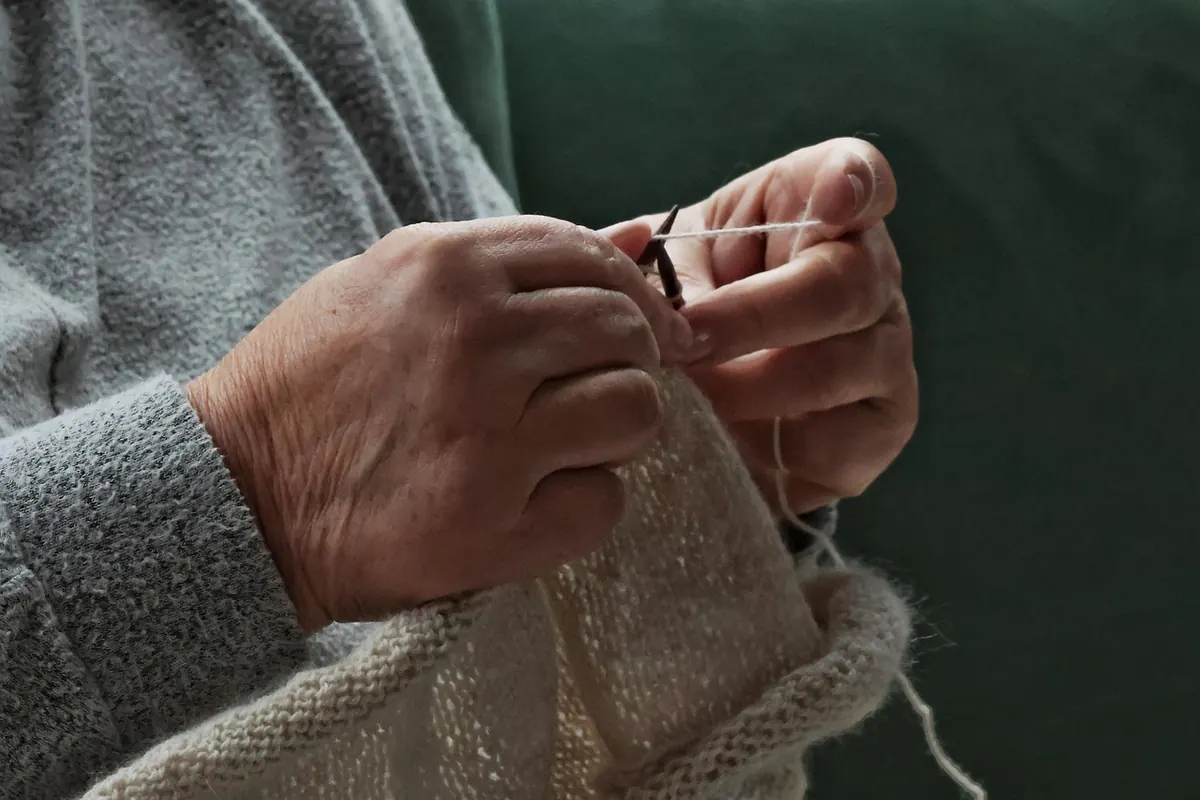
Somewhere in the back of a drawer there is a wool jumper that no longer fits, has a hole in one elbow, or came out of a hot wash looking like it belongs to a smaller, denser person. Don't bin it. Wool that has already started to shrink is halfway to felt, and felt is the perfect ground for a buzzard — a bird with a broad, unmistakable shape that is forgiving to cut and genuinely satisfying to stitch.
This project takes an afternoon plus drying time. You will end up with a 40 cm cushion, a bird that reads as a buzzard rather than a generic blob, and a useful understanding of how wool behaves when you push it around with a needle.
Not every knit will work. Wool felt because its fibres have scales that open up in heat and alkali, then lock together when they are agitated. Acrylic, polyester and cotton simply will not do it, no matter how hot the wash. Look for 70 per cent wool or more: lambswool, Shetland, Aran and merino all felt beautifully. If the label says "superwash" or "machine washable wool", put it back — that wool has been treated specifically to resist the process you are relying on.
Charity shops are ideal hunting grounds. So are the jumpers you have accidentally shrunk already, and anything with moth damage around the cuffs, since you will be cutting the fabric up anyway. Mottled and marled yarns are a bonus: they give the bird's plumage an instant depth that a flat colour cannot match.
Put the jumper in the machine on its own, or with a couple of old towels for friction. Use a hot cycle — 60°C is a sensible starting point — with a small amount of non-biological detergent. No fabric conditioner, ever; it coats the fibres and stops them gripping. A tumble dry on a hot setting afterwards tightens things further.
Purists call this fulling rather than felting, since the fibres are already spun into yarn. Either way, the result you want is a fabric that has shrunk by roughly a third, feels dense and slightly fuzzy, and no longer shows individual stitches clearly. If it still looks like a jumper, wash it again.
Once dry, press the felted jumper flat with steam — this is the only point in the project where an iron helps rather than harms. Cut the seams apart and you will have a set of soft, thick panels. A felted knit does not fray, which means you can cut shapes with clean edges and no overlocking. It still has a little stretch, so handle it gently and avoid tugging shapes out of true.
The common buzzard is a broad-winged, short-tailed bird, and those two proportions are what make the silhouette recognisable. Get them right and even a simple shape will be identified instantly. Get them wrong — long slim wings, a long tail — and you drift towards a gull or a harrier.
Sketch on paper first, working at about 25 cm across. You want a small rounded head barely protruding from the shoulders, a compact body, and wings that look wide and rounded with clearly separated "fingers" at the tips. Hold the wings in a shallow V across the cushion rather than flat, as this is the posture a buzzard adopts when it soars. The tail should be short and fan-shaped, not elongated.
If your buzzard is destined for a plain cushion, cut it in one piece from dark felted wool. For a more interesting bird, work in layers: a dark brown body and head, cream underwings, brown-barred feather markings, and the dark carpal patches near the wrist of each wing. Those patches are one of the buzzard's most useful field marks, and they carry over beautifully into textiles.
This is the fastest route to a soft, feathered look. Lay the cut shape on the cushion front, put the whole thing on your foam mat, and jab a felting needle through the shape and into the backing fabric, working from the centre outwards. The barbs on the needle drag fibres from the shape down into the cushion and back up again, locking the two together. Keep the needle vertical to avoid snapping the tip, and work in small areas rather than stabbing at random.
Once the base shape is secure, add roving in thin wisps for feathering, barring and a paler chest. Build colour in layers — a little goes a long way, and you can always add more, but pulling felted fibre back out is miserable work.
A walking foot helps enormously here, because it feeds the felted knit through at an even rate instead of stretching it. Use a fresh 80/12 or 90/14 needle and a slightly longer stitch length than you would use on woven cotton.
Cut one front panel and two back panels. For a 40 cm pad, cut the front 42 cm square, then cut two back pieces 42 cm wide and 30 cm deep. Turn under and stitch a 1 cm hem along one long edge of each back piece. Lay the front face up, overlap the two back panels on top with their hemmed edges meeting in the middle, and pin. Sew all the way round with a 1 cm seam allowance, clip the corners, turn it right side out and press the seams gently. Slip the pad in through the envelope opening.
If your felted wool is thick, trim the seam allowance back to 5 mm before turning, and grade the corners rather than cutting them off entirely.
Wool felt does not enjoy hot water once it is made, so treat the finished cushion as hand wash only, in cool water, and dry it flat and square. Squeeze rather than wring. A soft brush run over the surface will lift any pilling, and loose wisps of roving can be re-needled at any time if a feather line starts to look tired.
If the bird looks slightly wrong once it is on the cushion, resist the urge to start again. Nine times out of ten the wings are too narrow or the tail too long, both of which can be corrected by needle-felting extra fibre along the leading edge of the wing or over the tail tip. Add the darker carpal patches last — they pull the whole silhouette together and give the eye something to read.
Keep your offcuts. A felted jumper produces a surprising amount of usable fabric, and the scraps make excellent legs, beaks and small birds for future projects.
Photo: Tho-Ge / Pixabay
Turn recycled paper, flour paste and patience into a lightweight owl sculpture. A step-by-step beginner's guide to...
Bind a handmade falconry journal with raptor motifs and printed record pages — a weekend project that turns a...

Where to sketch live birds of prey in the UK, from red kite feeding hides to falconry displays, plus field technique...

Handcrafted art inspired by birds of prey.
